Representative Image

DWK Life Sciences Burette, 100 mL, Amber Glass Cl. As, Coc, White Marking, Straight PTFE Stopcock

Division

Height

Nominal capacity

Tolerance

Specifications

Compare models
Accuracy class
AS
Colour
Brown
Colour graduation
White
Division
0.2 ml
Height
870 mm
Material
Boro 3.3
Material stopcock
PTFE key
Nominal capacity
100 ml
Standard
ISO 835
Stopcock
Straight

RM 946.00

Inc. GST

Available soon

Product description

The DWK Life Sciences Burette, 100 mL, Amber Glass Cl. As, Coc, White Marking, Straight PTFE Stopcock supports routine bench-scale procedures, letting you meter titrant precisely down its 100 mL graduated column. It uses a straight PTFE stopcock that resists reagents and needs no greasing. The scale carries white graduations that read clearly against amber glass and dark liquids. Amber borosilicate glass shields light-sensitive titrants from degradation.

Key Features:

  • Brand: DWK Life Sciences
  • Product Type: Burette
  • Capacity: 100 mL
  • Accuracy Class: Class AS
  • Material: Amber borosilicate glass
  • Stopcock: Straight PTFE stopcock
  • Scale Marking: White marking
  • Application: Volumetric titration and precise liquid dosing

A solid choice for bench-scale titration, it holds calibration across routine use. Confirm the capacity and accuracy class fit your application.


Frequently Asked Questions

1. What is the DWK Life Sciences Burette, 100 mL, Amber Glass Cl. As, Coc, White Marking, Straight PTFE Stopcock used for?

The it supports routine bench-scale procedures, letting you meter titrant precisely down its 100 mL graduated column. It uses a straight PTFE stopcock that resists reagents and needs no greasing. The scale carries white graduations that read clearly against amber glass and dark liquids. Amber borosilicate glass shields light-sensitive titrants from degradation.

2. Is this product suitable for accurate liquid handling, measurement and preparation?

Yes. It is designed for accurate liquid handling, measurement and preparation, and offers a capacity of 100 mL to support this kind of work.

3. What capacity does this product have?

It has a capacity of 100 mL.

4. What is this product made from and what features does it include?

It is made from amber borosilicate glass. It also offers class AS, straight PTFE stopcock and white marking.

Compare similar models

Burette 100 ml, amber glass cl. AS, CoC, white marking, straight PTFE stopcock

Manufacturer P/N

243363901

Part Number

4.712 111

Manufacturer

DWK Life Sciences​

Division

0.2 ml

Burette 25 ml, amber glass cl. AS, CoC, white marking, straight PTFE stopcock

Manufacturer P/N

243363301

Part Number

4.712 109

Manufacturer

DWK Life Sciences​

Division

0.05 ml

Burette 50 ml, amber glass cl. AS, CoC, white marking, straight PTFE stopcock

Manufacturer P/N

243363601

Part Number

4.712 110

Manufacturer

DWK Life Sciences​

Division

0.1 ml

Burette 10 ml, amber glass cl. AS, CoC, white marking, straight PTFE stopcock

Manufacturer P/N

243362708

Part Number

4.712 108

Manufacturer

DWK Life Sciences​

Division

0.02 ml

More items to explore

Burette with straight stopcock, DURAN®, class AS, with glass key, brown

ProductNominal capacityMaterialMfr#Part#AvailabilityPrice
25 mlBoro 3.32432633034.712 105RM 830.50
10 mlBoro 3.32432627014.712 104RM 935.00
50 mlBoro 3.32432636034.712 106RM 935.00
100 mlBoro 3.32432639034.712 107RM 880.00

Frequently asked questions

The it supports routine bench-scale procedures, letting you meter titrant precisely down its 100 mL graduated column. It uses a straight PTFE stopcock that resists reagents and needs no greasing. The scale carries white graduations that read clearly against amber glass and dark liquids. Amber borosilicate glass shields light-sensitive titrants from degradation.

Insights

Explore
Cleaning Lab Glassware: Removing Stubborn Residue

1 min read

Cleaning Lab Glassware: Removing Stubborn Residue

Cleaning laboratory glassware properly is essential for accurate, safe, and repeatable lab work. This guide explains how to remove stubborn residue from beakers, flasks, bottles, volumetric glassware, and other lab glassware, including grease, dried salts, biological residue, stains, and burnt deposits. It also covers safe cleaning methods, common mistakes, drying and storage tips, and when damaged glassware should be replaced.
Read full story
How to Calibrate Your Pipettes to ISO 8655 Standards

1 min read

How to Calibrate Your Pipettes to ISO 8655 Standards

Pipette calibration helps laboratories confirm that liquid handling results remain accurate, repeatable, and traceable. This guide explains how pipettes are calibrated to ISO 8655 standards, including gravimetric testing, environmental control, correct tip selection, volume testing, calibration records, and common mistakes to avoid. It also covers when to use in-house calibration and when an external calibration service may be more suitable.

Read full story
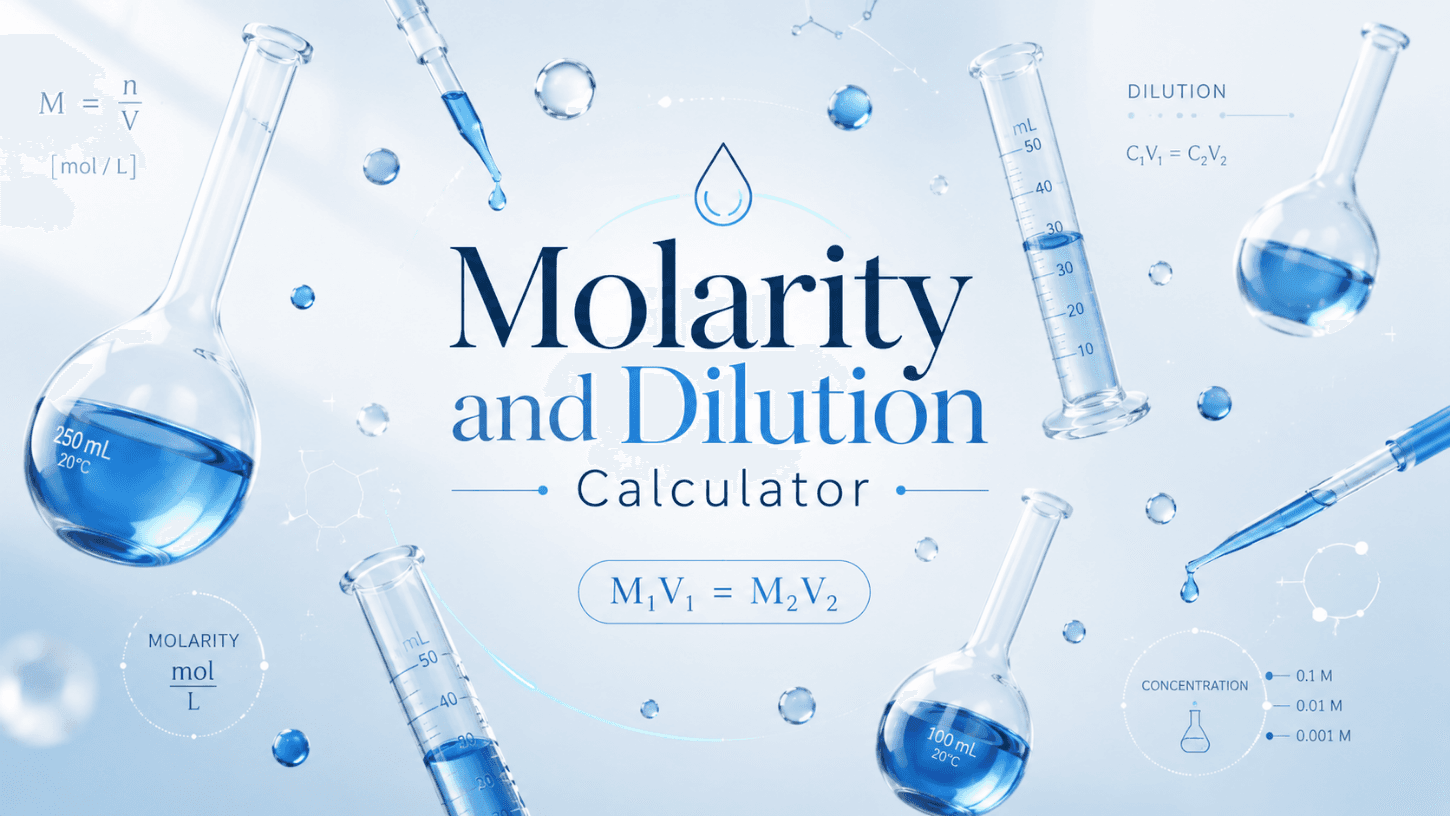
Molarity and Dilution Calculator

1 min read

Molarity and Dilution Calculator

A free molarity and dilution calculator covering four essential lab calculations: C1V1=C2V2 dilution (solve for any unknown), molarity from mass, mass from molarity, and serial dilution table generation. Includes worked examples, a concentration units guide and step-by-step preparation instructions for every result.

Read full story
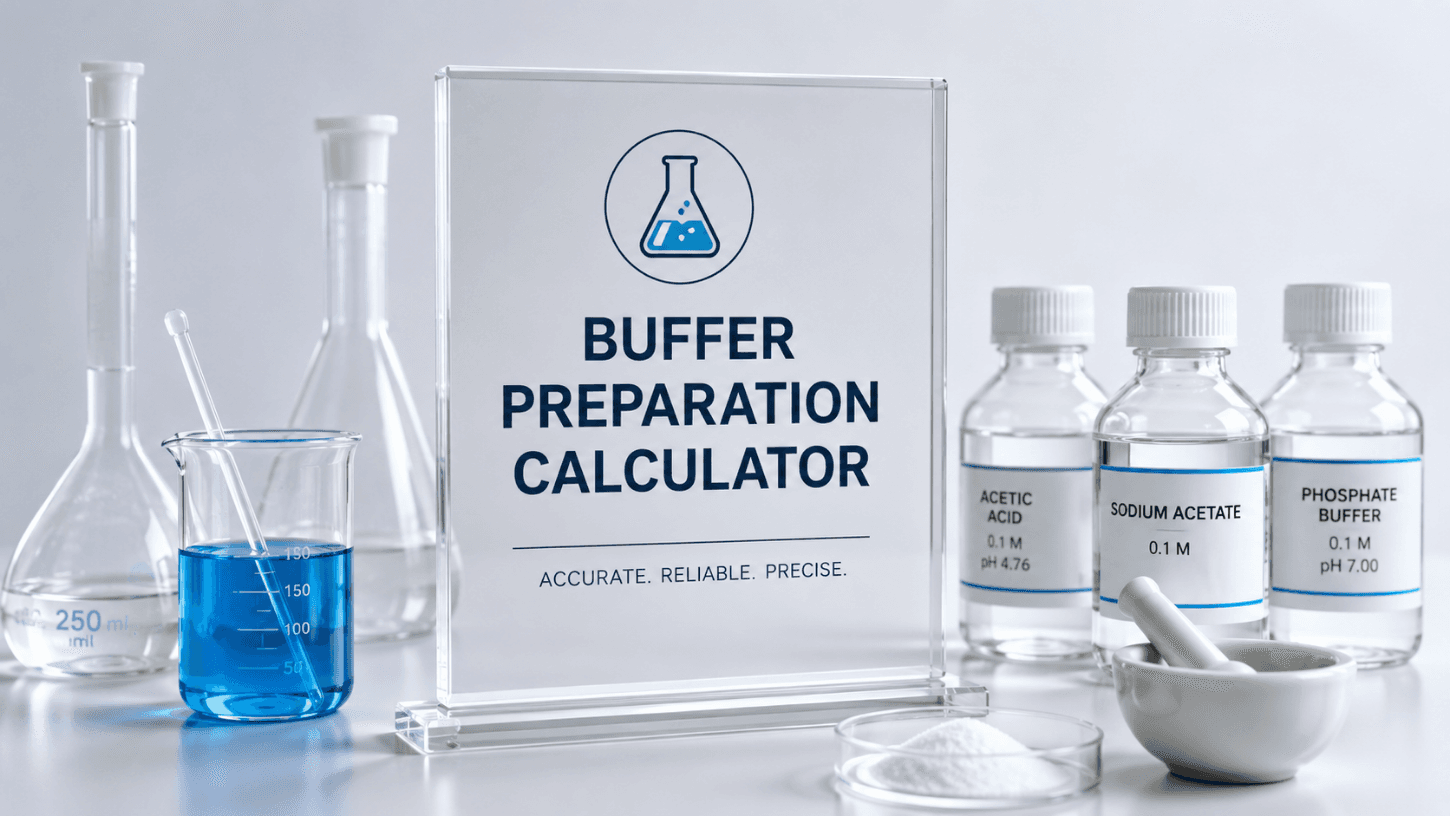
Buffer Preparation Calculator

1 min read

Buffer Preparation Calculator

Free online buffer preparation calculator. Select your buffer system, enter target pH, concentration and volume, and get an exact lab-ready recipe with reagent masses and step-by-step instructions. Covers PBS, Tris-HCl, sodium phosphate, acetate, HEPES, MOPS and more.

Read full story

RM 946.00

Inc. GST

MoQ (2)x(2)