Representative Image

Huber Unistat 405wl Dynamic Temperature Control System, 220-240 V, 1~/2~, 50/60 Hz

Specifications

Ext. dim. (WxDxH)
426 x 327 x 631 mm
Ext. depth
327 mm
Ext. height
631 mm
Ext. width
426 mm
Power supply frequency
50/60 Hz
Heating capacity
3 kW
IP code
IP 20
Max. delivery pressure
0.9 bar
Max. temperature
250 °C
Max. voltage
240 V

RM 163,988.00

Inc. GST

Available soon

Product description

The Huber Unistat 405wl Dynamic Temperature Control System, 220-240 V 1~/2~ 50/60 Hz is a highly dynamic temperature control system for precise heating and cooling in laboratories, pilot plants and industrial processes. Its compact design, fast thermal response and Pilot ONE touchscreen controller support demanding external temperature-control applications.

Key Features:

  • Brand: Huber
  • Voltage: 220-240 V
  • Heating: Fast heating and cooling rates
  • Control: Pilot ONE controller with 5.7" touchscreen
  • Connectivity: 2 x USB, Ethernet and RS232 interfaces

It is well suited to demanding reactor, process and pilot-scale temperature-control work where rapid heating and cooling and precise digital control are important.

Frequently asked questions

The Huber Unistat 405wl Dynamic Temperature Control System, 220-240 V 1~/2~ 50/60 Hz is a highly dynamic temperature control system for precise heating and cooling in laboratories, pilot plants and industrial processes. Its compact design, fast thermal response and Pilot ONE touchscreen controller support demanding external temperature-control applications.

Insights

Explore
Cleaning Lab Glassware: Removing Stubborn Residue

7 mins read

Cleaning Lab Glassware: Removing Stubborn Residue

Cleaning laboratory glassware properly is essential for accurate, safe, and repeatable lab work. This guide explains how to remove stubborn residue from beakers, flasks, bottles, volumetric glassware, and other lab glassware, including grease, dried salts, biological residue, stains, and burnt deposits. It also covers safe cleaning methods, common mistakes, drying and storage tips, and when damaged glassware should be replaced.
Read full story
How to Calibrate Your Pipettes to ISO 8655 Standards

7 mins read

How to Calibrate Your Pipettes to ISO 8655 Standards

Pipette calibration helps laboratories confirm that liquid handling results remain accurate, repeatable, and traceable. This guide explains how pipettes are calibrated to ISO 8655 standards, including gravimetric testing, environmental control, correct tip selection, volume testing, calibration records, and common mistakes to avoid. It also covers when to use in-house calibration and when an external calibration service may be more suitable.

Read full story
Molarity and Dilution Calculator

9 mins read

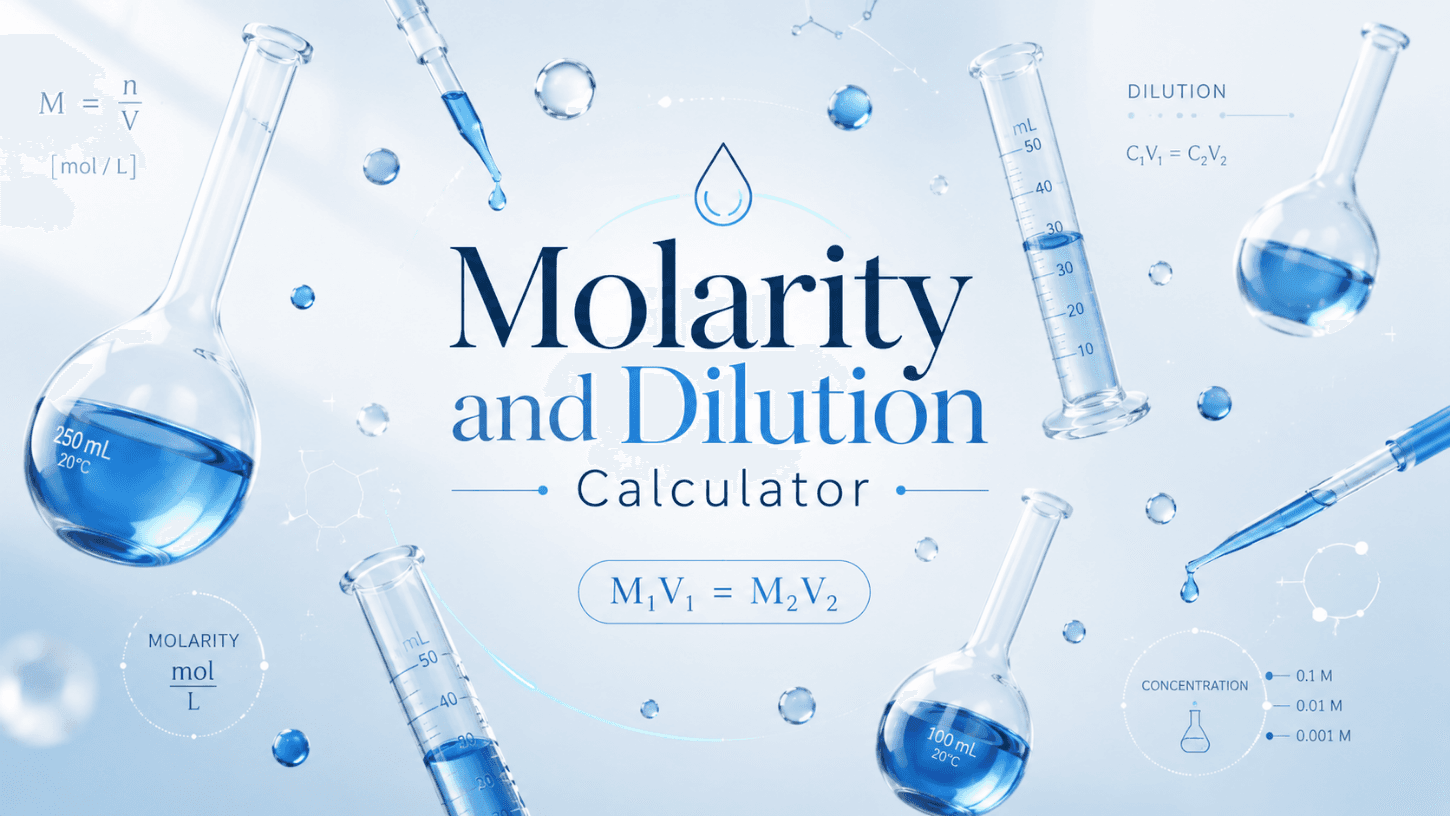
Molarity and Dilution Calculator

A free molarity and dilution calculator covering four essential lab calculations: C1V1=C2V2 dilution (solve for any unknown), molarity from mass, mass from molarity, and serial dilution table generation. Includes worked examples, a concentration units guide and step-by-step preparation instructions for every result.

Read full story
Buffer Preparation Calculator

9 mins read

Buffer Preparation Calculator

Free online buffer preparation calculator. Select your buffer system, enter target pH, concentration and volume, and get an exact lab-ready recipe with reagent masses and step-by-step instructions. Covers PBS, Tris-HCl, sodium phosphate, acetate, HEPES, MOPS and more.

Read full story